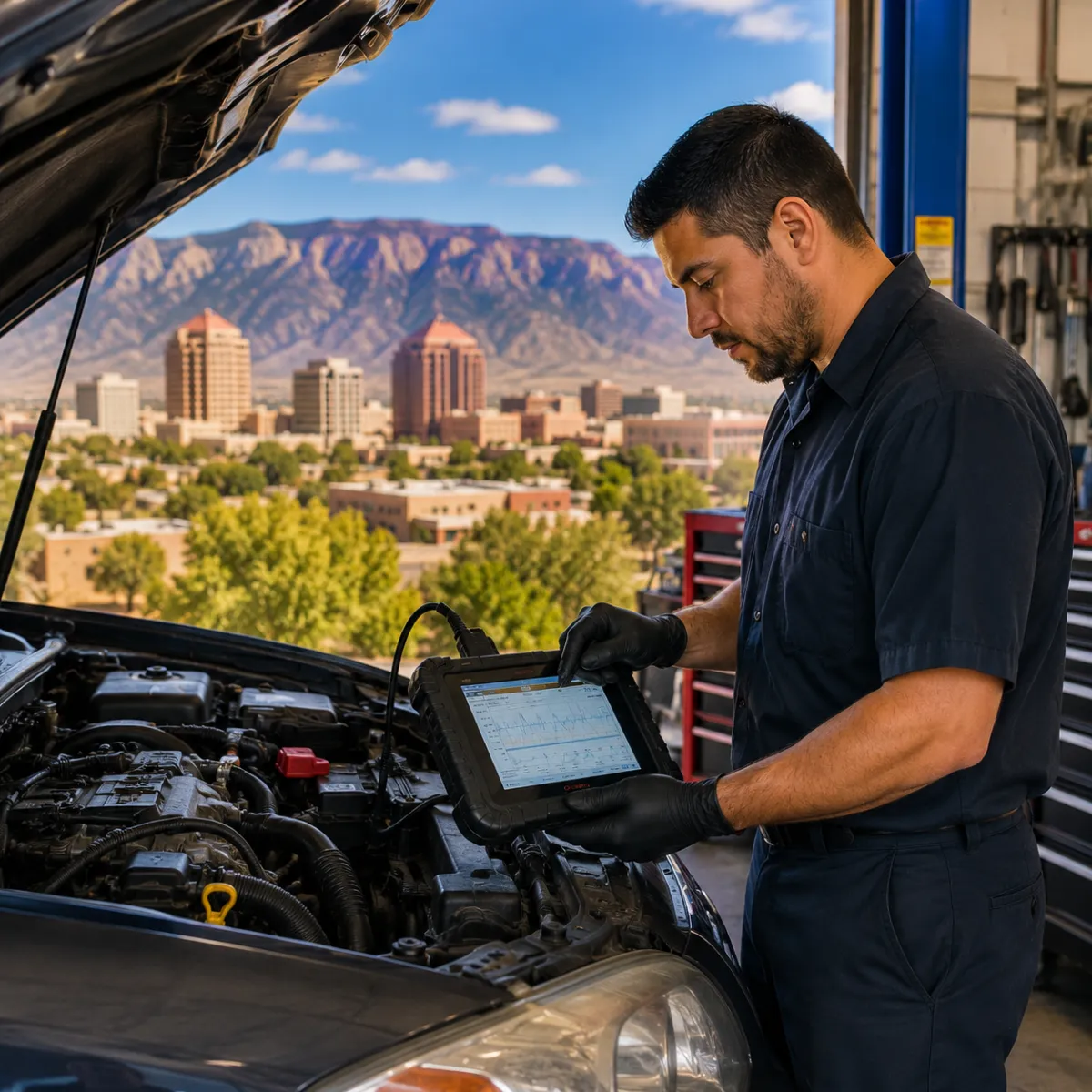
How We Handle Engine Diagnostics at Donny’s Automotive in Albuquerque, NM
When your check engine light comes on, your car starts running rough, or you hear a sound from under the hood that definitely wasn’t there yesterday, the first question is usually simple:
What’s wrong with my car?
The harder question is figuring out the right answer.
At Donny’s Automotive in Albuquerque, NM, engine diagnostics are about much more than plugging a scanner into your vehicle and reading a trouble code. A code gives us a place to start. It does not necessarily tell us which part needs to be replaced.
That distinction matters.
Modern vehicles contain complex computer systems, sensors, wiring, ignition components, fuel systems, emissions equipment, and mechanical parts that all have to work together. A problem in one area can create symptoms somewhere else.

Our diagnostic process is designed to narrow those possibilities down and find the actual cause of the problem before recommending a repair.
If you're experiencing a check engine light, rough idle, loss of power, hard starting, stalling, poor fuel economy, or another engine-related problem in Albuquerque, here's what happens when you bring your vehicle to Donny's Automotive.
What Is an Engine Diagnostic Test?
An engine diagnostic test is a systematic process used to determine why a vehicle isn't operating correctly.
Most vehicles on Albuquerque roads today have an onboard computer that monitors numerous systems and components. When the computer detects a condition outside its expected range, it may store a diagnostic trouble code and turn on the check engine light.
That code is useful, but it isn't always a diagnosis.
Think of it this way.
If you go to a doctor because your knee hurts, "knee pain" describes the symptom. It doesn't explain whether the problem is a ligament, tendon, joint, muscle, or something else.
Vehicle trouble codes work in a similar way.
A code can point a technician toward a system where the computer detected a problem. From there, additional testing may be necessary to determine why the code appeared.
That's where professional engine diagnostics become important.
Step 1: We Start With What You're Experiencing
One of the most useful diagnostic tools isn't electronic at all.
It's the information you give us.
When you bring your vehicle to Donny's Automotive, we want to understand exactly what you've noticed.
For example:
Did the check engine light come on suddenly?
Is the light flashing or staying on continuously?
Does the engine hesitate when accelerating?
Does the vehicle shake while idling?
Is it difficult to start in the morning?
Does the problem happen only after the engine gets hot?
Have you noticed lower gas mileage?
Did the problem begin after another repair?
Those details can dramatically narrow the diagnostic path.
A vehicle that stalls only when hot may require a very different investigation from one that struggles to start first thing in the morning.
That's why good engine diagnostics begin with listening.
Step 2: We Perform an Initial Inspection
Before jumping to conclusions, we look at the vehicle and the symptoms we're dealing with.
Depending on the complaint, the initial inspection may involve checking visible components, fluid conditions, hoses, wiring connections, battery-related issues, unusual noises, leaks, or other obvious signs of trouble.
Sometimes a relatively simple issue can create symptoms that seem much more serious.
Other times, everything looks normal on the surface and deeper testing is needed.
The goal at this stage isn't to guess.
It's to gather information.
Step 3: We Scan the Vehicle's Computer
For vehicles equipped with onboard diagnostics, scanning the computer is an important part of the process.
A professional scan can reveal stored diagnostic trouble codes and other information that helps point us toward the system experiencing the problem.
But this is where one of the biggest misconceptions about engine diagnostics comes in.
A Trouble Code Doesn't Automatically Mean "Replace This Part"
Suppose your vehicle stores a code associated with a particular sensor.
It can be tempting to assume:
Sensor code = bad sensor.
Sometimes that's correct.
Sometimes it isn't.
The sensor could be accurately reporting a problem caused somewhere else. Wiring could be damaged. A connector could have an issue. Another component could be affecting the readings. There could be an air, fuel, ignition, emissions, electrical, or mechanical problem influencing the system.
Replacing a part based only on a code can become expensive guesswork.
At Donny's Automotive, the scan helps guide the investigation. It doesn't automatically end it.
Step 4: We Look at the Data Behind the Code
Modern vehicle diagnostics can provide much more information than a simple trouble-code description.
Depending on the vehicle and the problem, technicians may examine operating information from different sensors and systems.
This data can help answer questions such as:
Is a sensor reporting something unusual?
Does the problem happen only at certain engine temperatures?
Is the engine receiving the information it should?
Are different readings consistent with each other?
Is the vehicle behaving differently at idle versus under acceleration?
The exact testing depends on the symptoms, vehicle, and codes present.
That's an important point.
There isn't one universal diagnostic procedure for every check engine light.
Diagnostics are a process of following evidence.
Step 5: We Test the Suspected System
Once we've narrowed the problem down, additional testing may be needed.
The specific tests depend entirely on what we're finding.
An engine performance problem could involve areas such as:
Ignition components
Fuel delivery
Air intake systems
Sensors
Electrical circuits and wiring
Emissions-related components
Vacuum or air leaks
Mechanical engine condition
Cooling-related issues
The objective is to move from "something is wrong in this system" toward "this is what's causing the problem."
That's the difference between reading codes and performing diagnostics.
Why Proper Engine Diagnostics Can Save You Money
Nobody wants to spend money replacing parts their vehicle didn't need.
Yet that's exactly what can happen when someone tries to diagnose a modern vehicle by guessing.
Imagine replacing a component because an inexpensive code reader pointed toward it.
The check engine light goes away temporarily.
Then it comes back.
Another part gets replaced.
The problem remains.
By the time the real cause is discovered, you've spent money on multiple repairs that didn't solve the original issue.
Professional diagnostics are intended to reduce that kind of unnecessary parts swapping.
The goal is straightforward:
Test first. Repair based on evidence.
Common Reasons Albuquerque Drivers Need Engine Diagnostics
We see many of the same concerns that drivers everywhere experience, but Albuquerque also presents its own driving environment.
Vehicles here deal with hot summer temperatures, high elevation, dry conditions, dust, stop-and-go city traffic, and highway driving on routes such as I-25 and I-40.
Whether you're commuting near UNM, heading through Nob Hill, driving across Albuquerque for work, or getting ready for a trip outside the city, an engine problem can quickly become inconvenient.
Common reasons to schedule diagnostic service include:
Check engine light
Flashing check engine light
Rough idle
Engine misfire
Loss of power
Hesitation during acceleration
Hard starting
Unexpected stalling
Poor fuel economy
Unusual engine noises
Engine running differently than normal
Even if the vehicle still drives, these symptoms deserve attention.
What Does a Check Engine Light Mean?
The check engine light is one of the most common reasons drivers seek engine diagnostics.
Unfortunately, it is also one of the most misunderstood dashboard warnings.
A check engine light can appear for many reasons, ranging from relatively straightforward issues to problems that need prompt attention.
The important thing is not to assume the severity based solely on how the vehicle feels.
Your car may appear to drive normally while the computer has detected a problem.
What If the Check Engine Light Is Flashing?
A flashing check engine light should be taken seriously.
It can indicate a condition that may require immediate attention. Continuing to drive under certain fault conditions could potentially lead to additional damage.
If your check engine light is flashing, especially if the engine is shaking, losing power, or running very poorly, contact a qualified repair shop for guidance rather than simply continuing to drive and hoping it clears up.
Can I Diagnose My Car With a Code Reader?
Basic code readers can be useful.
They can tell you which diagnostic trouble codes are stored in the vehicle's computer, and that information can provide a starting point.
The limitation is interpretation.
Knowing a code and knowing why that code appeared are two different things.
Online searches can make the problem even more confusing. You might search your code and find ten people who replaced ten different components.
They may all have had the same code.
They didn't necessarily have the same underlying problem.
That's why professional diagnosis involves testing the vehicle in front of us instead of assuming every vehicle with the same trouble code needs the same repair.
Albuquerque's Driving Conditions Can Be Hard on Vehicles
Albuquerque is a unique environment for cars and trucks.
Summer temperatures can put additional demand on cooling and air-conditioning systems. Dust and dry conditions are part of everyday driving. Elevation can also affect how engines operate and how certain problems present themselves.
Then there are the miles.
A typical Albuquerque driver might spend one part of the day in stop-and-go traffic and another cruising at highway speeds along I-25 or I-40.
That variety makes routine maintenance and early diagnosis important.
If your vehicle suddenly feels different, don't ignore it just because it still gets you from point A to point B.
Small changes can provide useful clues.
What Happens After We Find the Problem?
Once testing points us toward the cause of the concern, the next step is explaining what we've found and what repair is recommended.
You shouldn't need an automotive engineering degree to understand what's happening with your vehicle.
Our goal is to make the situation understandable so you can make an informed decision.
That means separating the symptom from the cause and explaining why a particular repair is being recommended.
For example, there is a big difference between saying:
"Your car has this code."
and saying:
"We tested the system associated with that code, and here's what we found."
The second gives you useful information.
Why Experience Matters With Modern Engine Diagnostics
Cars have changed dramatically.
Even systems that once seemed primarily mechanical can now interact with computers, sensors, modules, and electrical networks.
That means good diagnostics require more than owning a scanner.
They require understanding how vehicle systems interact and knowing what to test next when the obvious answer isn't the correct one.
A scanner provides information.
A technician has to interpret it.
That human part of diagnostics still matters.
When Should You Schedule Engine Diagnostics?
If your vehicle is behaving differently than normal, sooner is generally better than later.
Consider scheduling an inspection if you notice:
A newly illuminated check engine light
Recurring dashboard warnings
Rough running
A noticeable decrease in power
Unexplained fuel economy changes
Starting problems
Stalling
Strange engine sounds
Persistent hesitation
A repair that didn't solve the original problem
Waiting doesn't necessarily make a problem easier or less expensive to repair.
Getting the vehicle checked gives you information.
And information makes it much easier to decide what to do next.
Engine Diagnostics Near Me in Albuquerque, NM
If you've searched for "engine diagnostics near me," "check engine light Albuquerque," or "auto repair Albuquerque NM," you're probably not looking for a technical lecture.
You want to know what's wrong with your vehicle and what needs to happen next.
That's exactly what the diagnostic process is supposed to accomplish.
Donny's Automotive serves Albuquerque drivers from our Central Avenue location:
Donny's Automotive
Address: 12910 Central Ave SE, Albuquerque, NM 87123
Phone: (505) 312-2455
Our location is convenient for drivers on Albuquerque's East Side and those traveling along Central Avenue, with access to major routes serving the Albuquerque metro area.
For information about our automotive products and services, visit donnysautomotive.com.
Frequently Asked Questions About Engine Diagnostics in Albuquerque
How long does an engine diagnostic take?
There isn't one standard amount of time for every vehicle. Some problems can be identified relatively quickly, while intermittent or complex issues may require additional testing. The time depends on the symptoms, stored codes, vehicle design, and what technicians discover during the diagnostic process.
Does a check engine light always mean something expensive is wrong?
No. A check engine light can be triggered by many different conditions. Some are relatively straightforward, while others can involve more complicated repairs. The purpose of diagnostics is to determine what's actually causing the warning before assuming the worst.
Can you tell what's wrong just by reading the code?
Not always. A diagnostic trouble code identifies a condition the vehicle's computer detected. Additional testing may be necessary to determine the underlying cause.
Can I keep driving with the check engine light on?
That depends on the problem. A steady check engine light and a vehicle that appears to operate normally is different from a flashing light accompanied by shaking, loss of power, overheating, or other serious symptoms. When in doubt, contact a repair professional for guidance.
Why did my check engine light come back after replacing a part?
The replaced component may not have been the root cause of the original trouble code. Another problem in the system could be responsible. That's one reason testing and verification are important before replacing components.
Do Albuquerque's heat and elevation affect vehicles?
Albuquerque's climate, elevation, driving conditions, and summer heat can influence vehicle operation and place demands on multiple systems. Keeping up with maintenance and investigating unusual symptoms early can help drivers identify problems before they become larger concerns.
Don't Guess at an Engine Problem, Diagnose It
When something goes wrong with your vehicle, the temptation is to search the symptoms online, buy a part, install it, and hope the problem disappears.
Sometimes you get lucky.
But modern vehicles are complicated enough that guessing can become expensive quickly.
At Donny's Automotive, our approach to engine diagnostics in Albuquerque, NM is built around a simple principle:
Find evidence. Identify the cause. Then determine the appropriate repair.
If your check engine light is on, your vehicle is running rough, or something simply doesn't feel right, give us a call.
Donny's Automotive
12910 Central Ave SE
Albuquerque, NM 87123
(505) 312-2455
donnysautomotive.com
Call (505) 312-2455 to schedule engine diagnostic service, or stop by our Central Avenue shop in Albuquerque.
And after your visit, consider leaving Donny's Automotive a review. Sharing your experience helps other Albuquerque drivers find a local auto repair shop when they're facing a vehicle problem of their own.
